The journal
Native plants for a Nassau front yard
Inkberry for the hedge, switchgrass for the sunny corner, serviceberry for the birds: a short list that grows here, and the invasive plants New York no longer allows.
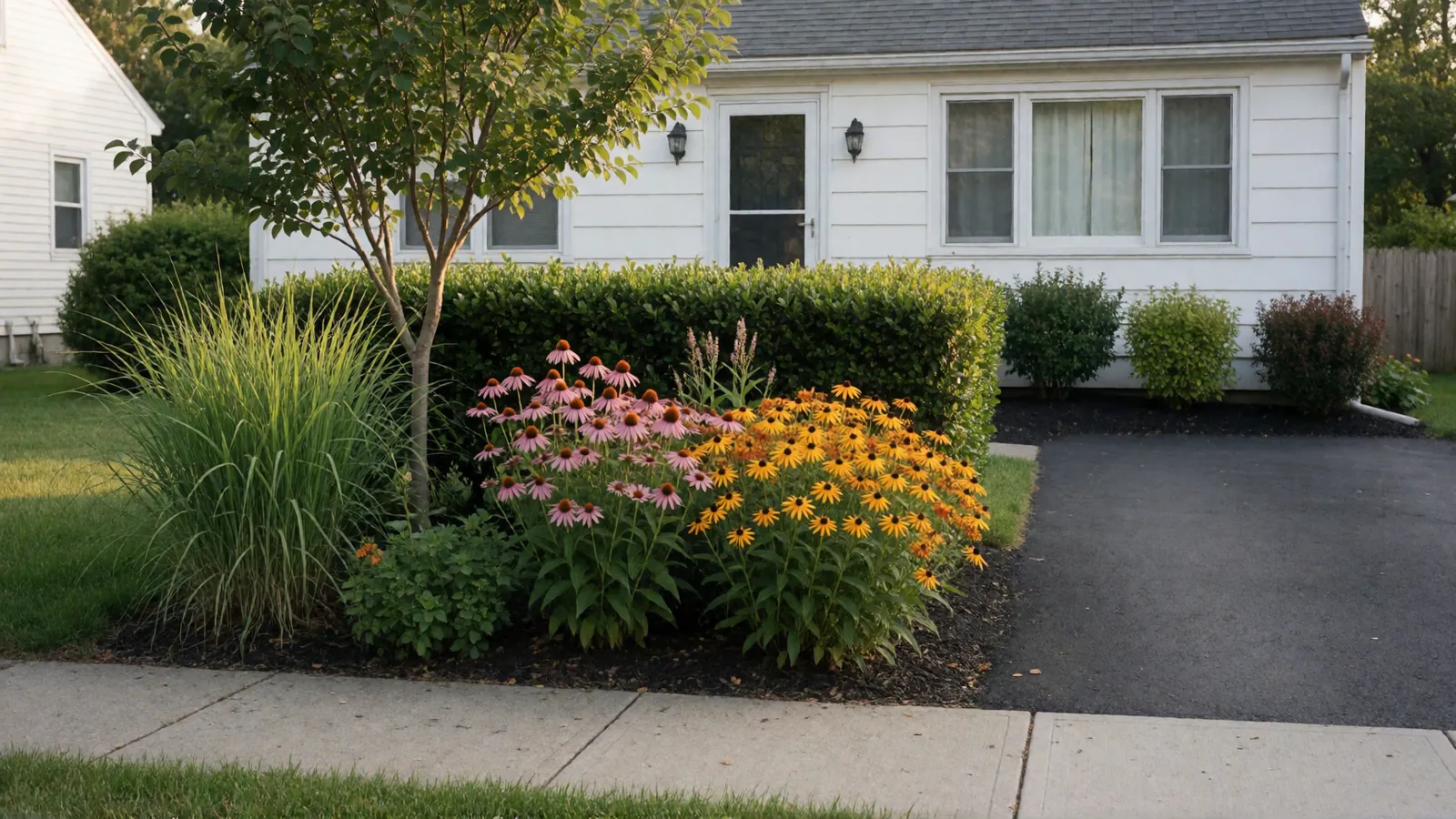
AI-generated illustration. Not a real home or business.
A front yard in Nassau is usually a lawn, a walk, a bed along the front of the house and a tree near the curb. The bed is where the plants that grew wild on Long Island can do the most, and it is also where several of the shrubs planted here for a long time are now against the law to plant at all.
Thirteen of the eighteen plants on this company's list are native to Long Island. This is what each is for.
Why natives first
A plant that grew here before the houses did is suited to the sandy, acid soil of much of the island, to the wind, and to a dry spell in August. Once it has settled in, it needs less watering than the shrubs it replaces, and it shrugs off the winters.
Natives also feed things. Most of the caterpillars that songbirds raise their young on feed on the leaves of the plants they evolved with, so a bed of natives is a bed the birds use, not just look at. The berries of the native shrubs ripen when the birds that eat them are passing through.
Teodora Vance-Mbeki, the garden designer, draws the planting plans and lays out every bed before a spade goes in. Teodora starts every plan with the sun: where it falls at nine, at noon and at four. Her plant lists start with the natives that grow wild on this part of Long Island.
Shrubs for the hedge and the foundation
Inkberry holly is the plant to know. It is an evergreen hedge or foundation shrub, where boxwood used to go: an evergreen that takes clipping into a low hedge, grows in sun or part shade, and puts up with wet ground. Where an old foundation planting has thinned out, it is usually the first replacement.
Winterberry holly drops its leaves in the fall and keeps its fruit, which is the point of it: red berries on bare branches all winter. It needs a male plant of the same kind somewhere nearby to set fruit, so plants are bought in a group.
Inkberry holly
An evergreen hedge or foundation shrub, where boxwood used to go.
Summersweet
Late-summer flowers in a damp, part-shade bed.
Winterberry holly
Red berries on bare branches all winter.
Arrowwood viburnum
A tall, loose screen along a back fence.
Bayberry
A tough, fragrant shrub for a sunny, sandy strip.
A small tree for the front
A front yard rarely has room for a shade tree, and a small tree is in scale with a Cape Cod or a split-level. Serviceberry gives white spring flowers and summer berries for the birds, then a soft orange in the fall. Plant a small tree well back from the walk and the house, where it can spread.
Serviceberry
White spring flowers and summer berries for the birds.
Eastern redbud
Pink flowers on bare branches in April.
Grasses and flowers for the sunny corner
The hot, dry corner by the driveway, where nothing else does well, is where the native grasses belong. Switchgrass is an upright grass that stands through the winter, so the corner still has a shape in January. Cut the grasses back once, at the spring clean-up, before the new growth comes up.
Among the flowers, butterfly weed is the one for orange flowers in a dry, hot corner, and it is one of the plants monarch caterpillars feed on. Leave the seed heads of the others standing through the winter: the finches eat them.
Switchgrass
An upright grass that stands through the winter.
Little bluestem
A short blue-green grass that turns copper in the fall.
Black-eyed Susan
A long summer of yellow in full sun.
Purple coneflower
A pollinator bed that looks after itself.
Butterfly weed
Orange flowers in a dry, hot corner.
Under the trees, where grass gives up
Every street-tree yard has a patch under the canopy where the lawn has thinned to moss and roots. Seeding it every fall is a losing fight. Pennsylvania sedge is a soft groundcover under trees where grass gives up, and it needs mowing once a year at most.
Pennsylvania sedge
A soft groundcover under trees where grass gives up.
Well-behaved shrubs from elsewhere
Not everything in a good bed has to be native. A few plants from elsewhere stay where they are put and are worth their place. Boxwood is one, for a clipped edge, where it stays healthy; where it has struggled with blight, inkberry takes the same clipped shape.
Panicle hydrangea
Big summer flowers that take full sun.
Oakleaf hydrangea
Flowers, then red fall leaves, in part shade.
Boxwood
A clipped edge, where it stays healthy.
Daylily
A reliable edge along a sunny walk.
Catmint
A blue haze along a patio from May to frost.
What New York no longer allows
Some of the shrubs and trees that were the standard hedges and screens of Long Island are on New York's lists of invasive plants. They spread from yards into woods and wetlands, where they crowd out what grew there, and the State now prohibits some and regulates others.
What New York no longer allows. Japanese barberry, border privet, the running bamboos, sycamore maple and Amur cork tree may not be sold or planted in New York at all, and Norway maple, burning bush and Chinese silver grass are regulated. We plant none of them, and we can take an old barberry or bamboo screen out.
Where one of them is already in a yard and its owner wants it gone, the natives above do the same jobs: inkberry for an evergreen hedge, arrowwood viburnum for a tall screen along the back fence, switchgrass for an upright grass in a sunny bed.
- 6 NYCRR 575.3 (opens the source in a new tab) No one may sell, buy, transport, introduce or propagate a prohibited invasive species in New York.
- 6 NYCRR 575.4 (opens the source in a new tab) A regulated invasive species may be sold, but no one may knowingly introduce it into the wild.
Planting, and the first season
Shrubs and perennials go in most easily in spring and in early fall, when the soil is workable and the heat is off. The first season is the one that decides whether a planting takes, and most of it is water:
Water new shrubs and perennials deeply twice a week for the first month, then once a week to the end of the season, unless it rains an inch.
Water at the base, early in the morning, and not on your town's off days.
Keep mulch two inches deep and pulled back from the stems.
Don't fertilize new plantings in their first season unless the plan says so.
Tell us in the first month if anything wilts and won't recover overnight.
Start with an estimate visit
Book an estimate visit, at least twenty-four hours ahead. There's no charge for it, and nothing has to follow it.