About
Frequently asked
The estimate, the price, the route day, the rain, the three days, the snow, the garden, and the things we don't do.
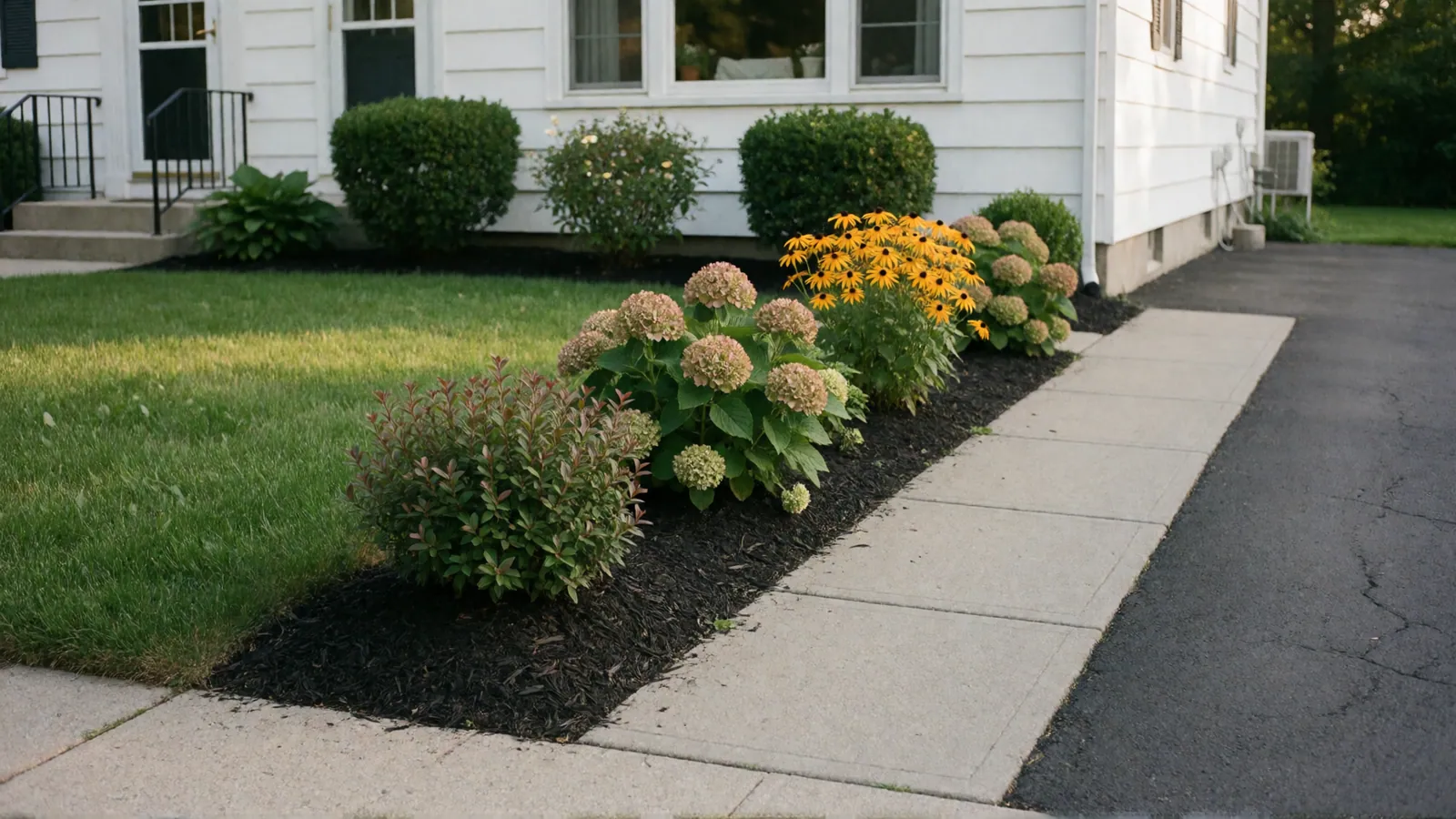
AI-generated illustration. Not a real home or business.
The questions people ask over the fence
Every answer here is the same sentence the agreement, the booking form and the confirmation e-mail use.
Do I need an estimate visit, and what does it cost?
Every job starts with an estimate visit. There's no charge for it, and you don't have to book anything after it.
How long does the estimate visit take?
An estimate for weekly lawn care, a clean-up or snow takes about thirty minutes; for planting, a patio, a wall or sprinklers, or for an association's or a business's grounds, about an hour.
Do I have to be home?
You choose a one-hour arrival window, and the estimator arrives inside it. For a lawn estimate you don't need to be home; for a garden, a patio or sprinklers, please be. Your crew comes on that weekday every week, at some point in the working day, and you don't need to be home: leave the gate unlocked and the dog inside.
What does a weekly visit cost?
A weekly visit is priced from the lot: eight minutes, plus a minute and six-tenths for every thousand square feet, counted up to the whole minute, for a crew of two, and ten minutes for the drive to the next stop, at $130 a crew-hour, rounded to the nearest five dollars and never under $45. A corner lot, with twice the edging, takes a tenth longer. The estimator gives the price for the band your lot is in, both ends. The estimate visit measures the lot and puts the price for the lot as measured on the agreement.
What does a whole season cost?
For a 6,000 square feet lot in Mineola with a spring clean-up, two leaf visits, four feeding rounds and the sprinkler visits, the thirty-three visits of a season come to $3,180.00 before tax, and $3,454.42 with Nassau's 8.625%, invoiced visit by visit.
Is sales tax included in the prices?
Every price here is before sales tax, which is added to each invoice as its own line at the rate where the work is done: 8.625% in Nassau County and 8.875% in Queens. In New York, mowing, clean-ups, feeding, sprinkler visits and snow removal are taxed as services to a property.
Do I pay anything online or up front?
Nothing is paid on this website, and nothing is paid in advance. Each visit is invoiced after it's done, with the sales tax on its own line, and you pay by card, check or bank transfer.
What day will you come?
A season plan has a route day, not a time. Your crew comes on that weekday every week, at some point in the working day, and you don't need to be home: leave the gate unlocked and the dog inside.
What happens when it rains?
Wet grass tears and ruts, so a rained-out day moves to the next working day of the same week, Saturday at the latest. A visit we can't make by Saturday is skipped and not invoiced. A route day that falls on a holiday moves the same way.
Can I skip a week?
Away for a week, or the lawn doesn't need it in a dry August? Skip that week's visit from its own page until 6 pm the evening before. A skipped visit is not invoiced, and the rest of the season stays as it was.
Do you bag the clippings?
Clippings stay on the lawn, mulched fine by the mower: they return nitrogen to the soil and never go in a bag.
Do you kill weeds or grubs?
We don't apply weed killers, crabgrass preventers, grub, tick or mosquito controls, or any other pesticide, including the ones sold as natural or organic. In New York a weed is a pest in law, so all of those need a State-registered business, a certified applicator, a written contract naming the products, warning flags on the lawn and, in Nassau County and New York City, written notice to your neighbors forty-eight hours before. We feed, seed, aerate and mulch, and we pull and cut weeds by hand and by machine.
When do you fertilize, and with what?
A season plan can carry four feeding rounds: late April, early June, early September and late October. Each rides on that week's visit and is its own line on that visit's invoice. New York doesn't allow lawn fertilizer between December 1 and April 1, and Nassau County not between November 15 and April 1. We hold every address to the Nassau window, so no feeding round is ever applied before April 2 or after November 14. We feed without phosphorus. New York allows it on an established lawn only when a soil test shows the lawn needs it, or in a new lawn's first season, and the office writes either on your plan before a crew carries any.
Is it safe for my dog and my children?
We don't put any pesticide on a lawn. Fertilizer goes on the lawn and nowhere else: anything that lands on a driveway, a walk or the street is swept back onto the grass, and nothing goes on within twenty feet of a pond or a stream. Keep pets off a newly fed lawn until it has been watered in or rained on, as the bag says.
Is there a contract, and does it renew?
A season plan ends by itself on its last visit, which the agreement names as its completion date. Nothing renews. In January we ask whether you'd like another season; that is a new agreement, with its own three business days.
Can I change my mind after I sign?
If you sign an agreement for your home — a season plan, a job, a snow contract or an install — you can cancel it until midnight of the third business day after you sign, and you owe nothing. Nothing is done, delivered or marked on your property before then. We give you the cancellation form with the agreement, and we tell you about this right out loud.
Why can't you start the day after I sign?
The first visit is on your route day after your three business days end. There is no way to start sooner: the law in Nassau County does not allow work to begin before then, and we hold every address to the same rule.
How do I cancel?
You can cancel a season plan, a job or a snow contract at any time from its own page, by telephone or in writing, and there is never a fee. Inside the three business days you owe nothing at all; after them, you pay only for visits already made, or for a snow contract the parts for months that have begun.
What does a snow contract cost?
A season for a single-car driveway in Franklin Square is $495.00 before tax, in four parts of $123.75 with $10.67 of tax each. A snow contract is a fixed price for the season, December 1 to March 31, by the size of your driveway. It covers every snowfall of two inches or more: the driveway, the front walk, the steps and the public sidewalk in front, with ice melt on the walk and the steps.
When do you plow?
We start once two inches have fallen, make a second pass in a storm that passes six inches, and the route aims to have every driveway clear within eight hours after the snow stops.
If I have a snow contract, am I covered for the sidewalk?
Clearing the public sidewalk is the property owner's duty in law. In New York City and the Town of North Hempstead it has to be clear within four daytime hours after the snow stops, and the owner answers for an uncleared sidewalk. A snow contract means we do the clearing; it doesn't move that duty off you.
Why does a snow contract have to be signed by mid-November?
Snow contracts are signed between August 1 and November 15, so the three business days are over before the season starts. After that, telephone the office.
Do you design gardens?
A garden design starts at the property: what's there, what gets sun, where the water goes. You get a measured plan and a plant list, and our own crew plants it. We call the person who draws your plan a garden designer. In New York only someone the State has licensed may be called a landscape architect, or describe the work as landscape architecture.
Which plants do you use?
We plant natives first — inkberry, summersweet, serviceberry, switchgrass, little bluestem — and well-behaved shrubs like hydrangea and boxwood, and we never plant anything on New York's list of prohibited or regulated invasive plants.
Can you take out my bamboo or barberry?
Japanese barberry, border privet, the running bamboos, sycamore maple and Amur cork tree may not be sold or planted in New York at all, and Norway maple, burning bush and Chinese silver grass are regulated. We plant none of them, and we can take an old barberry or bamboo screen out.
Do you build patios and walls?
We build patios, walkways and steps in pavers or bluestone, edge planting beds, and build garden and retaining walls up to three feet. Driveways, public sidewalks, curbs and taller walls are for a contractor who builds those. Planting, a patio, a garden wall and a new sprinkler system are quoted in writing after an estimate visit, on a home improvement contract that names the work, the materials, the price, the start and completion dates and the stages of payment.
Do you call before you dig?
Before any machine digs, we call 811 so the utilities can mark their lines, and New York has us wait two full working days after the call. Planting with spades and shovels needs no call. Nothing is delivered, marked or dug before your three business days are over, so the 811 call comes after them too.
Do you do sprinklers?
We start sprinklers in the spring, blow them out with compressed air in the fall, and repair heads, valves and controllers. A new system is laid from the backflow preventer onward, always with a rain sensor; the backflow preventer itself is installed and tested every year by your licensed plumber.
Can you take a tree down?
We trim hedges and shrubs by hand. We don't remove or prune trees, grind stumps or work on street trees: Nassau County lists tree surgery as a trade of its own, and in New York City work on or within 50 feet of a City tree needs a Parks permit first.
Are you licensed?
In Nassau County a landscaper needs the County's home improvement license even to mow lawns, and prints its number in every ad; in New York City, building a patio, a garden wall, a planting bed or a sprinkler system needs the City's home improvement contractor license. This is a demonstration company: it holds no license, so no number is shown, and nothing here is an offer of work.
Do you work for co-ops and businesses?
Co-ops, condominium and homeowners' associations, offices and shops are walked with the board or the manager and quoted in writing, with the same weekly visit, clean-ups and snow.
Are your blowers loud?
Every blower and string trimmer we use is battery-powered, which is why no summer leaf-blower ban stops a visit. Garden City has one from the Saturday before Memorial Day to Labor Day, and the Town of North Hempstead another from June 15 to September 15.
Start with an estimate visit
Book an estimate visit, at least twenty-four hours ahead. There's no charge for it, and nothing has to follow it.