Gardens
What we plant, natives first
Eighteen plants by their generic names, thirteen of them native to Long Island, and nothing from New York's invasive plant lists.
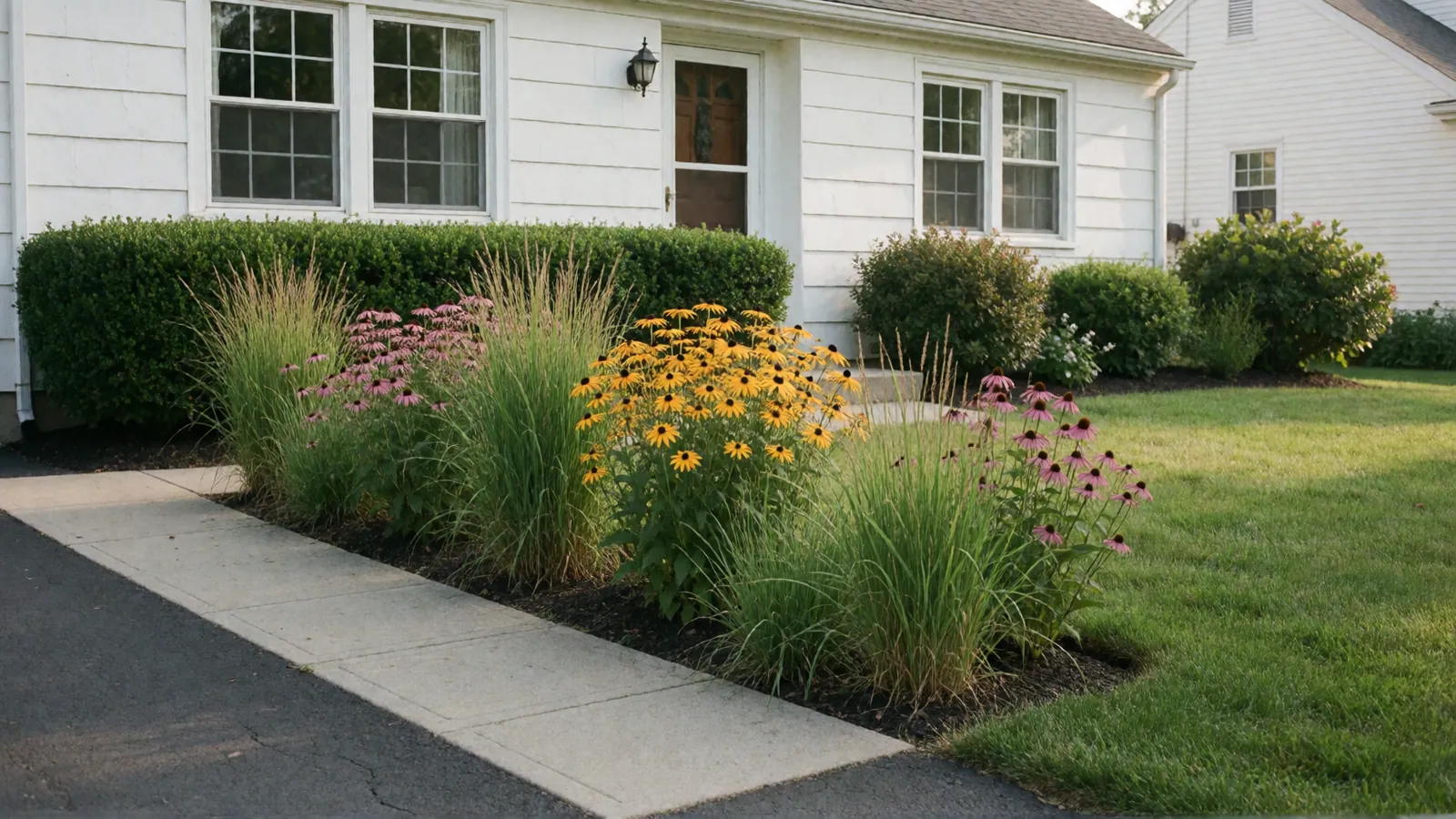
AI-generated illustration. Not a real home or business.
Natives first
Thirteen of the eighteen plants on this list grow wild on Long Island.
Natives first. We plant natives first — inkberry, summersweet, serviceberry, switchgrass, little bluestem — and well-behaved shrubs like hydrangea and boxwood, and we never plant anything on New York's list of prohibited or regulated invasive plants.
| Plant | What it is | Native | Where it earns its place |
|---|---|---|---|
| Inkberry holly | shrub | Yes | an evergreen hedge or foundation shrub, where boxwood used to go |
| Summersweet | shrub | Yes | late-summer flowers in a damp, part-shade bed |
| Winterberry holly | shrub | Yes | red berries on bare branches all winter |
| Arrowwood viburnum | shrub | Yes | a tall, loose screen along a back fence |
| Bayberry | shrub | Yes | a tough, fragrant shrub for a sunny, sandy strip |
| Serviceberry | small tree | Yes | white spring flowers and summer berries for the birds |
| Eastern redbud | small tree | Yes | pink flowers on bare branches in April |
| Switchgrass | grass | Yes | an upright grass that stands through the winter |
| Little bluestem | grass | Yes | a short blue-green grass that turns copper in the fall |
| Black-eyed Susan | perennial | Yes | a long summer of yellow in full sun |
| Purple coneflower | perennial | Yes | a pollinator bed that looks after itself |
| Butterfly weed | perennial | Yes | orange flowers in a dry, hot corner |
| Pennsylvania sedge | groundcover | Yes | a soft groundcover under trees where grass gives up |
| Panicle hydrangea | shrub | No | big summer flowers that take full sun |
| Oakleaf hydrangea | shrub | No | flowers, then red fall leaves, in part shade |
| Boxwood | shrub | No | a clipped edge, where it stays healthy |
| Daylily | perennial | No | a reliable edge along a sunny walk |
| Catmint | perennial | No | a blue haze along a patio from May to frost |
By the job each one does
A plant earns its place by what the yard needs from it: a hedge, a screen, a wet corner, a dry strip.
Shrubs
Inkberry holly (native): an evergreen hedge or foundation shrub, where boxwood used to go. Summersweet (native): late-summer flowers in a damp, part-shade bed. Winterberry holly (native): red berries on bare branches all winter. Arrowwood viburnum (native): a tall, loose screen along a back fence. Bayberry (native): a tough, fragrant shrub for a sunny, sandy strip. Panicle hydrangea: big summer flowers that take full sun. Oakleaf hydrangea: flowers, then red fall leaves, in part shade. Boxwood: a clipped edge, where it stays healthy.
Small trees
Serviceberry (native): white spring flowers and summer berries for the birds. Eastern redbud (native): pink flowers on bare branches in April.
Grasses
Switchgrass (native): an upright grass that stands through the winter. Little bluestem (native): a short blue-green grass that turns copper in the fall.
Perennials
Black-eyed Susan (native): a long summer of yellow in full sun. Purple coneflower (native): a pollinator bed that looks after itself. Butterfly weed (native): orange flowers in a dry, hot corner. Daylily: a reliable edge along a sunny walk. Catmint: a blue haze along a patio from May to frost.
Groundcovers
Pennsylvania sedge (native): a soft groundcover under trees where grass gives up.
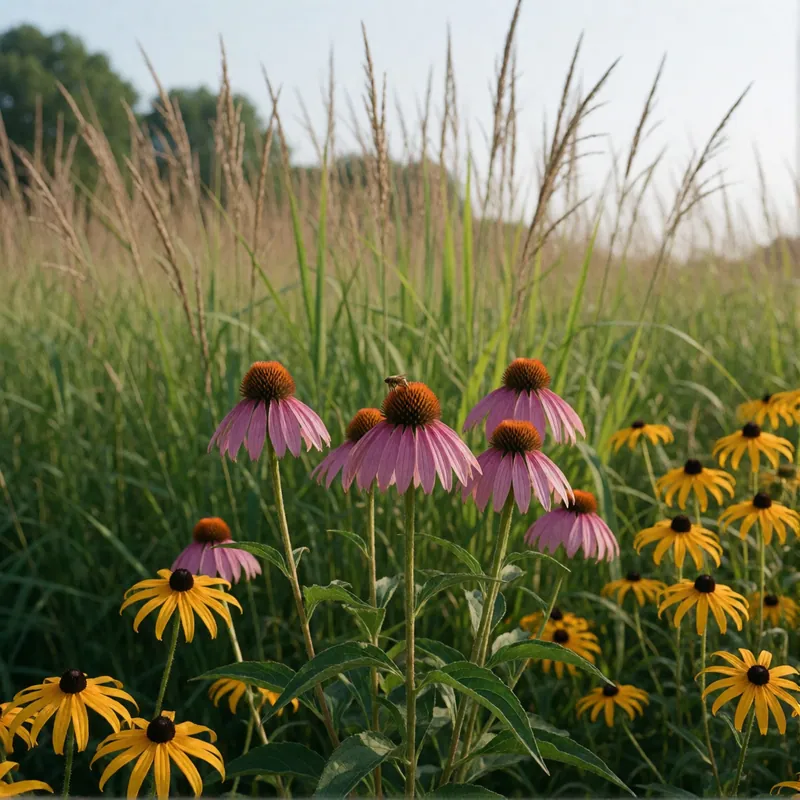 AI-generated illustration. Not a real home or business.
A plant that grows wild here already suits the sandy soil, the summers and the cold, and the birds and the insects here feed on it. That is why a plan starts with the natives and adds a well-behaved shrub where the job calls for one.
Every name here is a generic one. The variety, how tall, how wide and which color, is chosen for your yard on the plan. Teodora starts every plan with the sun: where it falls at nine, at noon and at four.
What New York no longer allows
What New York no longer allows. Japanese barberry, border privet, the running bamboos, sycamore maple and Amur cork tree may not be sold or planted in New York at all, and Norway maple, burning bush and Chinese silver grass are regulated. We plant none of them, and we can take an old barberry or bamboo screen out.
Some of the shrubs most planted on Long Island in the last century are on the State's lists now, because they spread from gardens into the woods and crowd out what grew there.
Every one of them was doing a job: a hedge, a screen, a tall grass by the patio. The list above does the same jobs. For a hedge there is inkberry holly, an evergreen hedge or foundation shrub, where boxwood used to go; for a screen, arrowwood viburnum, a tall, loose screen along a back fence; and for the tall grass, switchgrass, an upright grass that stands through the winter.
Who draws the plan
A garden designer. We call the person who draws your plan a garden designer. In New York only someone the State has licensed may be called a landscape architect, or describe the work as landscape architecture.
Teodora Vance-Mbeki, the garden designer. Draws the planting plans and lays out every bed before a spade goes in. Teodora's plant lists start with the natives that grow wild on this part of Long Island.
The rules this page follows
Each is described in a sentence of its own.
- 6 NYCRR 575.3 (opens the source in a new tab) No one may sell, buy, transport, introduce or propagate a prohibited invasive species in New York.
- 6 NYCRR 575.4 (opens the source in a new tab) A regulated invasive species may be sold, but no one may knowingly introduce it into the wild.
Start with an estimate visit
Book an estimate visit, at least twenty-four hours ahead. There's no charge for it, and nothing has to follow it.