The journal
When to aerate and overseed on Long Island
Why September beats April for seed, what core aeration actually does to clay and compacted soil, and how to water new seed without washing it into the street.
AI-generated illustration. Not a real home or business.
Most people think about grass seed in spring, when the lawn looks thinnest and the bags are stacked by the door at every hardware store. On Long Island it is the wrong time of year. Seed sown in April comes up into a summer it isn't ready for. Seed sown at the end of summer has a fall and a spring to grow roots before it meets its first August.
Why the end of summer
Grass seed wants warm soil to sprout and cool air to grow. At the end of summer the soil still holds the heat of July and August, so seed comes up in days rather than weeks, and the nights are getting longer and cooler, so the seedlings grow without the heat that stalls them. Rain is more regular than in midsummer, and dew keeps the surface damp in the mornings.
The weeds are on the other side of their year. Crabgrass and most of the annual weeds that compete with spring seed are finishing and setting seed by then, not starting, so the new grass has the light to itself. And a seedling that comes up in September has the fall and then the whole of the spring to put roots down before it has to live through a hot, dry spell.
Seed goes down from late August to mid-October, when the soil is warm and the nights are cool. On this company's agreements the window is August 25 to October 15.
Spring seeding isn't impossible. It works on a bare patch that can be watered, and it needs watching through June. As a way to thicken a whole lawn, the end of summer does it with far less loss.
What core aeration does
A lawn that is walked on, played on and mowed every week packs its soil down. On heavier soils, and anywhere a path has been worn to the gate or the shed, water runs off instead of soaking in, and the roots stay near the surface where it is dry by July.
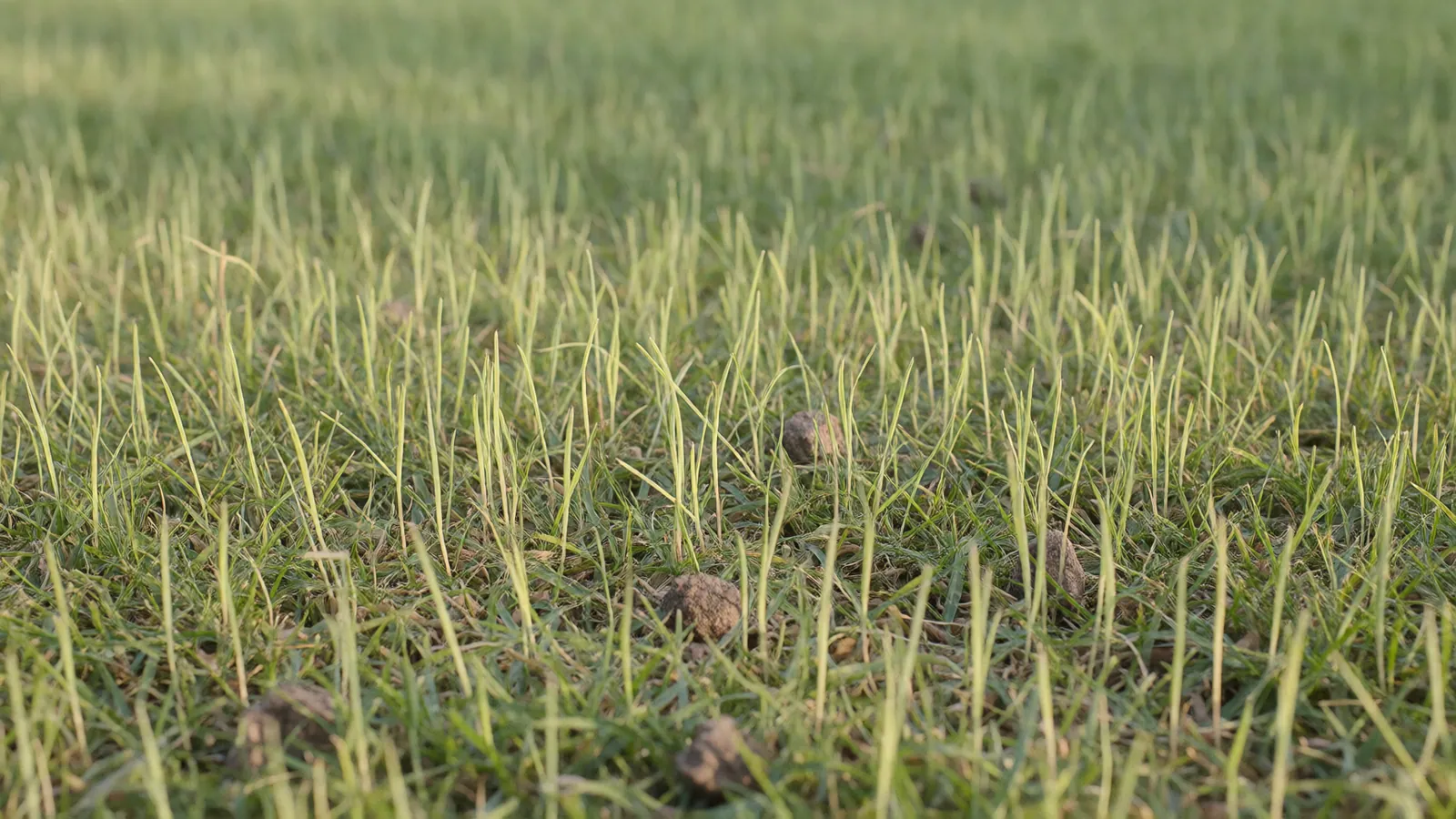
A core aerator pulls plugs of soil out of the lawn, each about the size of a finger, a few inches apart across the whole lawn. The holes let air and water down to the roots and give the packed soil room to loosen. The plugs are left where they fall: a week or two of rain and mowing breaks them up, and they put a little soil back over the thatch. A spike aerator, which just pokes holes, presses the soil around each hole tighter, which is the opposite of the point.
Then the seed goes down, into the holes and over the lawn, where it has soil to land in instead of a mat of old grass. That is why the two are done together. Aeration alone opens the soil; seed alone sits on top of it; the two in one visit put seed into the ground. The seed here is a tall fescue blend, which roots deeper than ryegrass and holds up better in a dry summer.
What it costs here
Core aeration and overseeding is priced from the lot: $200, plus $28 for every thousand square feet of lot, rounded to the nearest five dollars. This is the agreement for a lawn in Garden City, signed on Thursday, August 12, 2027, with its date inside the window and its tax on its own line. The three business days to change your mind come first, so the date falls after them.
Core aeration and overseeding for a 10,000-square-foot lawn A house in Garden City
- Core aeration and overseeding, Wednesday, August 25, 2027an hour and a half; tax $41.40$480.00
- Before taxone visit$480.00
- Sales tax (8.625%, Nassau County)on each visit's invoice$41.40
- In allinvoiced visit by visit$521.40
Signed on Thursday, August 12, 2027. The three business days to cancel end at midnight on Monday, August 16, 2027, so the first visit is Wednesday, August 25, 2027.
No pesticide of any kind. We don't apply weed killers, crabgrass preventers, grub, tick or mosquito controls, or any other pesticide, including the ones sold as natural or organic. In New York a weed is a pest in law, so all of those need a State-registered business, a certified applicator, a written contract naming the products, warning flags on the lawn and, in Nassau County and New York City, written notice to your neighbors forty-eight hours before. We feed, seed, aerate and mulch, and we pull and cut weeds by hand and by machine.
Watering new seed without washing it into the street
Until it is up, new seed needs the top of the soil damp, not soaked. Water it lightly, early in the morning and on your watering days, so the surface doesn't dry to a crust between waterings. A heavy soaking on a slope or beside the driveway carries the seed with it, and the seed ends up in a green line along the curb.
As the grass fills in, change the pattern: water longer and less often, so the roots follow the water down instead of staying at the surface. By the time the leaves are falling, a lawn seeded at the start of the window needs about what an established lawn does.
Set to your town's rules. In Nassau County lawns are watered on odd or even dates by house number and not between 10 am and 4 pm, and a new automatic system needs a rain sensor. We set every controller we touch to the rules of the address.
The weeks after
Keep foot traffic, and the dog, off the seeded lawn for the first few weeks. Don't mow until the new grass has grown past mowing height, and then take just the tips. The plugs on the surface will have gone by then.
And keep the leaves off it. A mat of wet leaves in October is the surest way to lose a seeding, because the seedlings are small enough to smother in a week. That is the other reason a seeded lawn needs its leaf visits.
Aeration, overseeding and mulch, why one leaf visit is rarely enough, and what a thick lawn does to weeds.
Start with an estimate visit
Book an estimate visit, at least twenty-four hours ahead. There's no charge for it, and nothing has to follow it.