The journal
How high to mow a Long Island lawn, and how often
Three to three and a half inches for tall fescue and bluegrass, never more than a third of the blade at once, and why a lawn mowed every other week in June turns yellow.
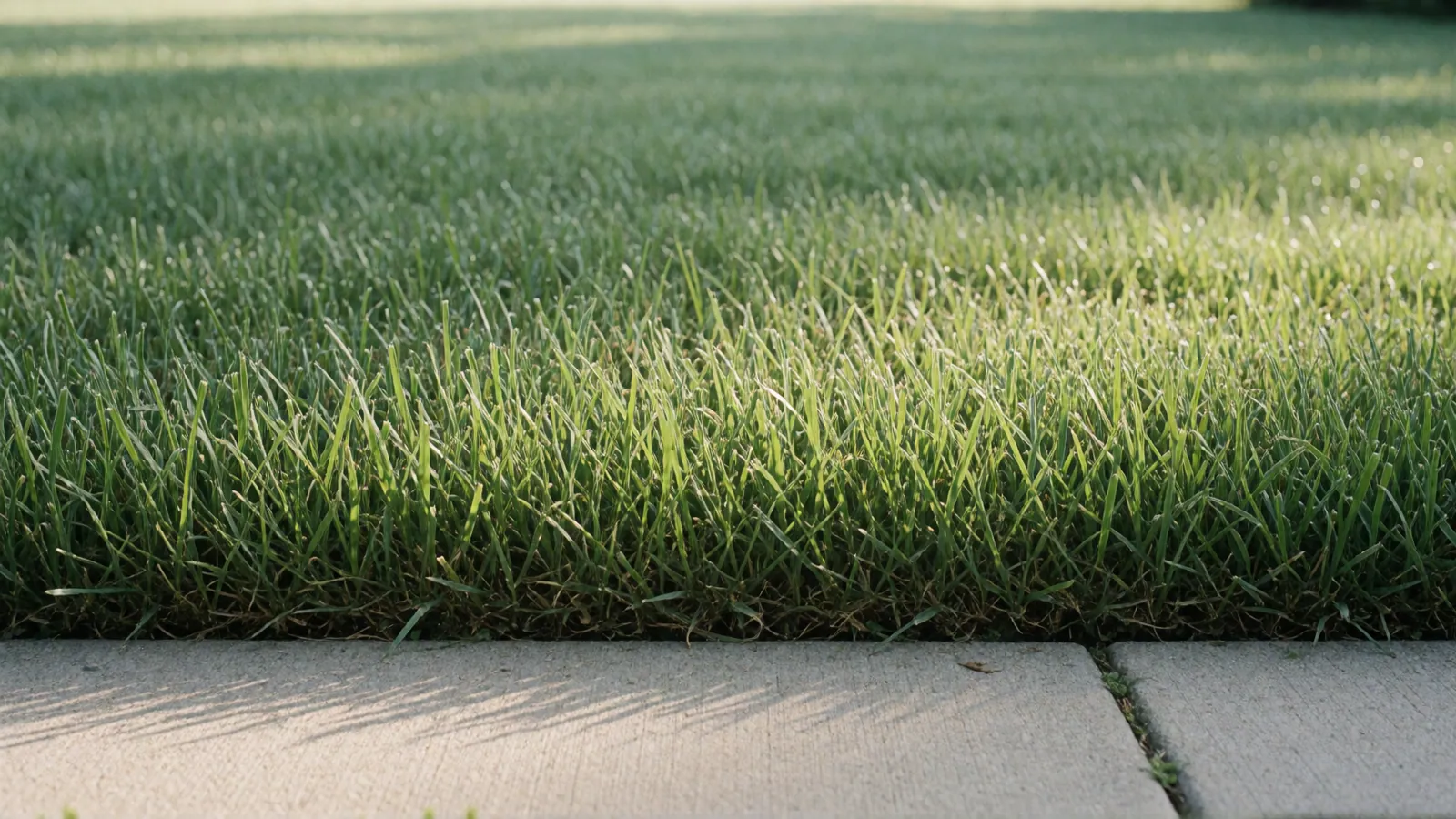
AI-generated illustration. Not a real home or business.
Most Long Island lawns that look tired in August were mowed too short in June. Height is the one thing about a cut that a homeowner can see and change, and it decides more about how a lawn looks at the end of summer than most people expect. Here is what the height should be, why, and why the calendar matters as much as the blade.
The grasses here
The lawns of western Nassau and eastern Queens are cool-season grasses: tall fescue, Kentucky bluegrass and perennial ryegrass, usually sown as a mix, with fine fescues where the shade is heavy. They grow hardest in the mild weather of spring and fall, and slow down in the heat of July and August, when a lawn left to itself goes straw-colored and waits for rain.
Each blade feeds the roots under it. The more leaf a plant keeps, the deeper the roots it can hold up, and the deeper the roots, the longer it stays green after the last rain. Everything about mowing height follows from that.
Three inches, and a little more in summer
For these grasses the working height is three to three and a half inches. Tall fescue is comfortable at the top of that range; a bluegrass lawn in full sun can sit nearer the bottom. In the heat of summer the extra half inch earns its place: taller grass shades the soil, the shaded soil stays cooler and holds its water longer, and crabgrass seed, which needs light and warm bare ground to sprout, finds less of both.
A lawn cut at two inches looks neat for a day and thin for the rest of the summer. It browns first in a dry spell, recovers last, and lets in the weeds that a taller lawn would have shaded out.
Never more than a third of the blade
The rule that matters more than any height is how much comes off at once: no more than a third of the blade in a single cut. Take more, and the plant loses the part of itself that feeds it. It stops growing roots in order to grow leaf back, and the cut ends of the blades turn pale.
In late May and June a cool-season lawn grows so hard that two weeks between cuts takes it well past the point a single cut can bring back without breaking that rule. That is why a lawn mowed every other week in June turns yellow: each cut takes off the green tops and leaves the pale stems underneath. Mowed every week, the same lawn loses a little each time and never shows it.
That is why a season plan here is a visit every week on your route day, from April 8 to November 21, and the same four things each time:
Every week, the same four things. Every weekly visit is the same four things: the lawn mowed, the edges along the driveway, the walks and the curb cut clean, the beds and the fence lines trimmed, and the walks, steps and driveway blown clear. The clippings stay on the lawn, where they feed it.
In a dry August the arithmetic turns around. The grass has nearly stopped growing, and a cut that week takes little and stresses a lawn that is already short of water. Skipping a week then is the right call, not a lapse.
Skip a week. Away for a week, or the lawn doesn't need it in a dry August? Skip that week's visit from its own page until 6 pm the evening before. A skipped visit is not invoiced, and the rest of the season stays as it was.
A sharp blade, dry grass, and the curb first
A dull blade tears the tip of each blade instead of cutting it, and a torn tip dries out and goes white. A lawn mowed with a dull blade looks gray from the street the next day. Wet grass tears the same way, clumps under the deck, and the wheels rut soft ground, which is why a rained-out day moves rather than going ahead.
When it rains. Wet grass tears and ruts, so a rained-out day moves to the next working day of the same week, Saturday at the latest. A visit we can't make by Saturday is skipped and not invoiced. A route day that falls on a holiday moves the same way.
Changing the direction of the cut from one week to the next keeps the grass from leaning one way and the wheels from wearing tracks in the same places. And on a corner lot the curb comes first. Desmond Achterberg-Ruiz runs the first crew's route through New Hyde Park and Garden City Park. Desmond edges a walk with a half-moon spade the first time, and keeps the line with the edger after that. On a corner lot Desmond starts at the curb, because that's the edge everybody sees.
Leave the clippings
Clippings stay on the lawn, mulched fine by the mower: they return nitrogen to the soil and never go in a bag. Clippings are mostly water, and cut fine and often they disappear into the lawn within a day or two. They are not what builds thatch, which is made of roots and stems, so there is no reason to bag them on a lawn mowed every week.
At the end of the season
As growth slows in late fall, the last cuts can come down toward the bottom of the range. A long lawn lying flat under leaves and then under snow is where the gray mold that shows up in March gets its start. The leaves come off before that, which is the subject of another article.
Weekly lawn care, why one leaf visit is rarely enough, and the price for your lot.
Start with an estimate visit
Book an estimate visit, at least twenty-four hours ahead. There's no charge for it, and nothing has to follow it.