The journal
Fall leaves: why one clean-up is rarely enough
Maples in October, oaks in November, sweet gums into December: why a yard with mixed trees needs two visits, and what your village's curb collection changes.
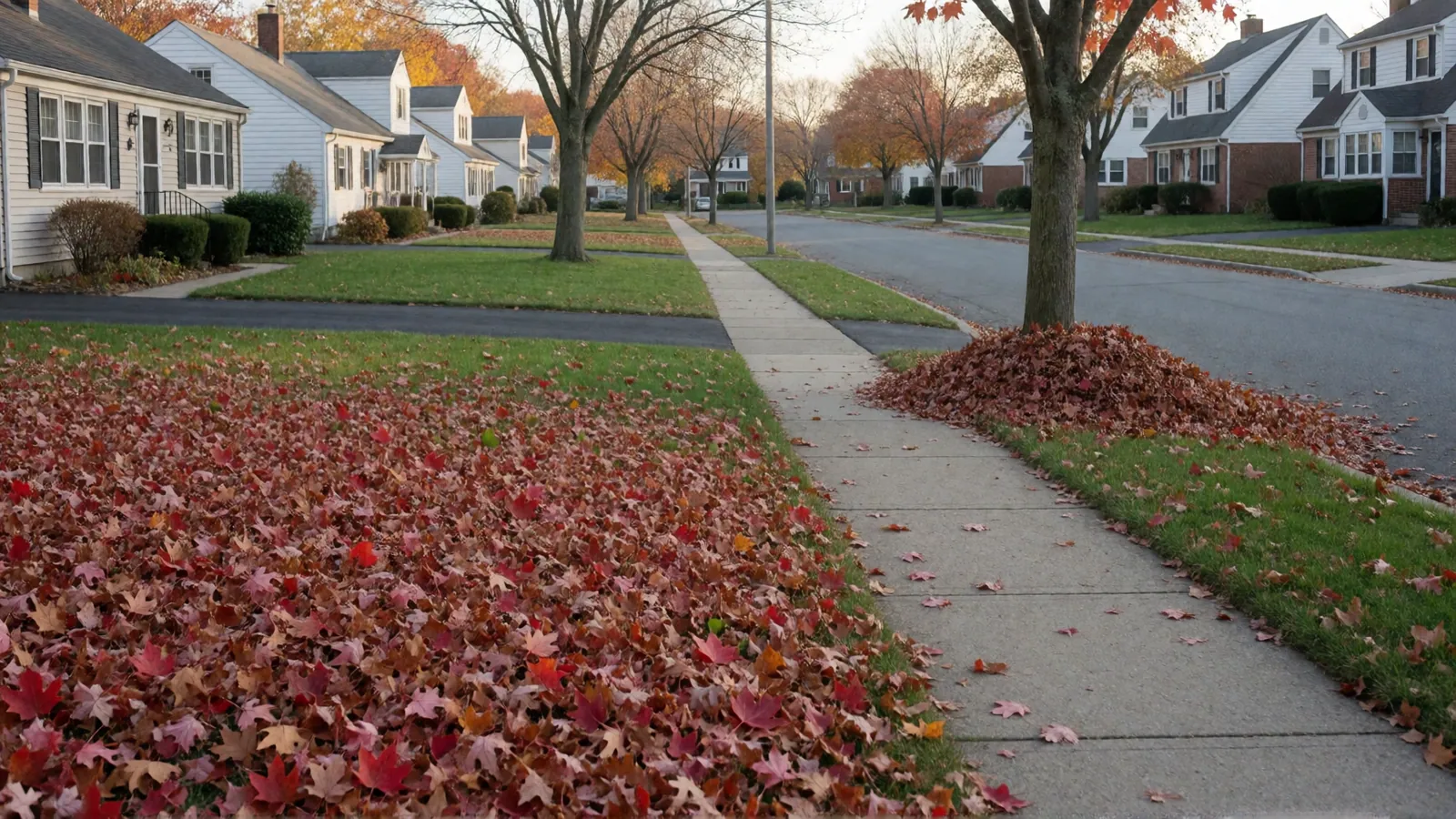
AI-generated illustration. Not a real home or business.
The first leaf clean-up of the fall is often done on a day when the maples are bare and the oaks still look like summer. Two weeks later the lawn is under leaves again. That isn't the crew missing anything. It is the order the trees drop in, and it is the reason a yard with mixed trees needs more than one visit.
The order the trees drop
The streets of western Nassau and eastern Queens are lined with maples, with oaks, sweet gums and lindens among them, and most backyards have a tree or two of their own. Maples turn and drop first, through October: a heavy fall over two or three weeks, and then they are done.
Oaks hold on. A pin oak keeps its brown leaves well into November, and some cling on into winter and come down in the first storms. Sweet gums, the ones with star-shaped leaves and spiky seed balls, drop late and slowly, some into December. A yard under a single maple can sometimes be finished in one late visit. A yard with an oak next door can't.
Two leaf visits, because the maples drop in October and the oaks hold on into November.
Two visits, dated before you sign
A season plan here carries two fall leaf visits, on the first route days from November 1 and November 15, each in place of that week's visit. Both are on the agreement with their dates before you sign. Each one is the same work:
Leaves blown off the lawn, the beds, the walks and the patio and bagged or piled at the curb, beds cleared, perennials cut back, and that week's cut.
Each is priced from the lot: $175, plus $30 for every thousand square feet of lot, rounded to the nearest five dollars. Without a season plan, a leaf visit is a one-off job on one weekday between October 20 to December 15.
Lucía Ferreira-Doyle runs the second crew's route through Mineola, Williston Park and Garden City. Lucía plans the fall leaf visits street by street, by which trees drop first. On a street of maples the first visit does most of the work; on a street of oaks the second one does.
Why not wait for one big visit
Waiting until every leaf is down sounds efficient, and it costs the lawn. Leaves that lie on grass for three or four weeks in the wet of November mat down into a layer that light can't get through, just when the grass is using the last mild days to store food for the winter. Under the mat it yellows, and under snow it is where the gray mold that shows up in March gets its start.
A lawn seeded at the end of summer is the most at risk. Its seedlings are small enough to smother in a week, and a wet October mat can undo the seeding.
Where the leaves go
Where the leaves go. Fall leaves are blown off the lawn, the beds and the walks and bagged, or piled at the curb where your town or village collects them in the fall; if you'd like them hauled away, the office quotes it.
Your town or village decides when and how it collects in the fall, and in what. The crew works to that: piled at the curb in the collection window where a village takes them loose, bagged where it wants bags. Leaves blown out into the street outside the window block the storm drains at the first heavy rain, and the water stands at the corner until someone clears the grate.
Every blower and string trimmer we use is battery-powered, which is why no summer leaf-blower ban stops a visit.
Between visits
A light scatter of leaves on the lawn can simply be mowed. A mower run over dry leaves chops them small enough to fall down between the blades of grass, where they break down over the winter. A layer you can't see the grass through is too much for that and needs raking or blowing off.
In the beds, a thin layer of leaves under the shrubs does what mulch does, and many gardeners leave it there. Keep it off the crowns of perennials and away from the stems, and keep it out of the low corners where it piles deep and stays wet.
Start with an estimate visit
Book an estimate visit, at least twenty-four hours ahead. There's no charge for it, and nothing has to follow it.